
How to Find the Source of a Flat Roof Leak in a Brooklyn Rowhouse
A ceiling stain in a Brooklyn rowhouse almost never tells you where the water got in. The roof deck, the joists, the parapet masonry and the plaster below it are all connected, and water follows the easiest path — not the shortest one. That is why so many homeowners patch the spot directly above the stain, feel relieved for a month, and then watch the same brown ring reappear after the next hard rain.
This guide walks through how a leak on a low-slope Brooklyn roof is actually traced: what you can safely observe from inside your own home, what the common failure points are, and what a roofer looks for once they are up there. Nothing here asks you to climb onto a roof.
If you already have active water coming in, skip ahead and call — emergency roof repair is a different conversation than diagnosis. For everything else, read on.
Why the stain is rarely under the hole
On a flat or low-slope roof, water that gets past the membrane lands on the roof deck. From there it runs along the deck until it finds a seam, a fastener hole, a joist bay or a pipe chase, and then drops. On a typical rowhouse that means the entry point can be ten or fifteen feet away from the visible damage — often on the opposite side of the roof from where the ceiling is stained.
Two Brooklyn-specific patterns make this worse:
So the first rule of leak tracing: treat the stain as evidence, not as the address.

Step 1: Document what you can see inside
Before anyone gets on the roof, the interior evidence narrows the search significantly. Walk the top floor with a phone and a flashlight and note:
That last point matters more than people expect. A leak that only shows up during driving rain from the north usually points to a vertical surface — a parapet face, a wall junction, a bulkhead — rather than the field of the roof. A leak that only shows up when snow melts often points to drainage that is blocked or frozen, not to a puncture.
Photograph everything and date the photos. If you eventually file with an insurer or compare two contractors' opinions, that record is worth having.
Step 2: The usual suspects on a Brooklyn flat roof
Once a roofer is on the roof, the inspection follows the failure points in rough order of likelihood.
Membrane seams
Single-ply membranes — TPO and EPDM — arrive in rolls and overlap at the seams. Modified bitumen is layered and lapped. Seams are where two materials rely on a weld, an adhesive or a torch bond to behave as one surface, and they are the most common place a roof stops being watertight. A roofer probes them by hand or with a seam tool, looking for cold welds, lifted laps and failures at T-joints where three layers meet.
Flashing at every vertical transition
Anywhere the flat surface turns upward — parapet base, bulkhead wall, chimney, the wall of a taller neighbouring building — there is flashing. It expands and contracts on a different schedule than the masonry it is attached to, so over years it loosens, tears at corners, or the sealant at its top edge dries out and pulls away. Corners are checked first; they are where flashing fails earliest.
Penetrations
Every plumbing vent, exhaust stack, condenser curb, conduit and antenna mount is a hole through the roof that depends entirely on a boot, a collar or a pitch pan. Rubber boots crack from UV. Pitch pan filler shrinks and leaves a dish that collects water. Anything installed by a trade other than a roofer — a new HVAC unit, a satellite mount — deserves particular attention.
Drains, scuppers and internal leaders
Brooklyn rowhouses commonly drain to an internal leader or a rear scupper. Debris, a failed drain clamp ring, or a cracked leader inside the wall will all present as a roof leak. A cracked leader is a genuinely nasty one to find, because it wets the inside of a wall with no sign at all on the roof surface.
Ponding
Water that sits on the roof more than a couple of days after rain is doing damage even where there is no leak yet. It loads the structure, degrades the membrane, and turns any small seam weakness into an open one. Where ponding and a leak appear in the same area, ponding is usually the reason a minor defect became a live leak. There is more on this in our guide to ponding water on a flat roof.
Parapets and coping
The parapet is its own building envelope problem: water enters from above through cracked or open coping joints, from the face through deteriorated mortar, and from the base where the flashing meets the roof. Because it can wet the inside of the wall, a parapet leak often appears at the top of an interior wall rather than on the ceiling. We cover this in detail in why NYC buildings get leaks at the roof edge.
Step 3: Confirming the source before anyone quotes work
Suspecting a source is not the same as proving it. A careful diagnosis confirms it before a repair is priced, using methods like controlled water testing — isolating one area at a time, starting at the lowest suspected point and working up, with someone watching inside — and moisture readings taken on the deck or in the insulation to map how far wet material extends.
The reason to insist on this: repairs priced off a guess are how a homeowner ends up paying twice. If a contractor cannot explain how water travels from the point they want to repair to the stain you are looking at, that explanation is missing for a reason.
What you should not do
When a repair is enough and when it is not
Seams, flashing, boots and drains are repairable, and a targeted flat roof repair is often the right answer even on an older roof. Replacement enters the conversation when there are multiple unrelated active leaks, when moisture readings show wet insulation over a large area, or when the membrane has become brittle across the whole field rather than at one detail. Those are things measured on the roof, not assumed from the ground.
Get the leak traced properly
IronSky works on rowhouse and brownstone roofs across Brooklyn and the rest of the city, and diagnosis comes before pricing. Request a free estimate below or call and describe what you are seeing inside — where, when, and in what weather. That conversation alone usually narrows it down before anyone arrives.
Get a Free Flat Roof Estimate
Licensed NYC roofers. Written, itemized quote. We respond within the hour during business hours.
- GAF Certified & Firestone Licensed
- Fully licensed & insured in NY State
- Free written estimate — no pressure
- Serving all 5 boroughs since 2008
Frequently Asked Questions
Why is my ceiling stain not directly under the roof damage?+
Water that passes the membrane runs along the roof deck until it finds a joint, fastener hole or pipe chase to drop through. On a Brooklyn rowhouse that path can be ten to fifteen feet, so the interior stain is often nowhere near the actual entry point.
Can I find a flat roof leak myself?+
You can gather most of the useful evidence from inside: where the staining is, whether it is active or historic, and in which weather conditions it appears. Locating the entry point on the roof itself requires walking seams, flashing, penetrations and drains, which is not safe or practical for a homeowner on a low-slope rowhouse roof.
My leak only appears in heavy wind-driven rain. What does that suggest?+
Directional leaks usually point to a vertical surface rather than the flat field of the roof — a parapet face, a wall junction with a taller neighbouring building, or a bulkhead wall. Wind pushes water sideways into openings that shed water fine in ordinary rain.
What is ponding water and does it cause leaks?+
Ponding is water that remains on the roof more than roughly 48 hours after rain, caused by blocked drainage, inadequate slope or structural settlement. It rarely creates a hole by itself, but it loads the roof and accelerates the failure of seams and details in that area.
Should the source be confirmed before I get a repair price?+
Yes. Ask the contractor to explain how water travels from the point they propose to repair to the damage you see inside. Controlled water testing and moisture readings are the normal ways of confirming that before work is priced.
Does a flat roof leak always mean the roof needs replacing?+
No. Failed seams, flashing, pipe boots and clogged drains are repairable. Replacement is normally considered when there are multiple unrelated leaks, when moisture readings show widespread wet insulation, or when the membrane has become brittle across the entire roof.
Need a roofer in NYC?
IronSky offers free estimates and 24/7 emergency service across NYC, Long Island and Yonkers.
Get Free EstimateRelated Articles
All posts
Water still sitting on your flat roof two days after the rain? Here is what causes ponding on NYC low-slope roofs, the damage it does before it leaks, and the repair options from drain work to tapered insulation.
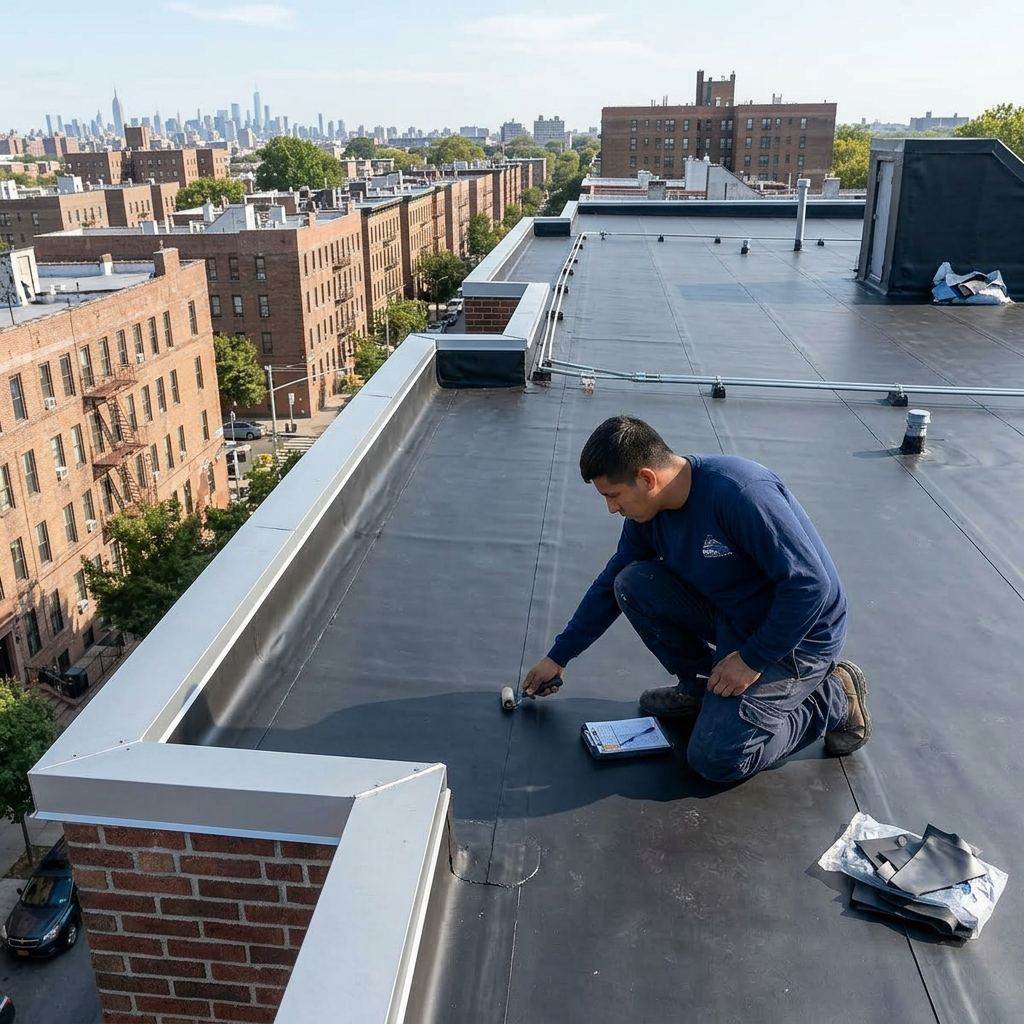
Discover the most common reasons NYC flat roofs leak — from failed flashing to ponding water — and how IronSky fixes them fast. Free inspections available.
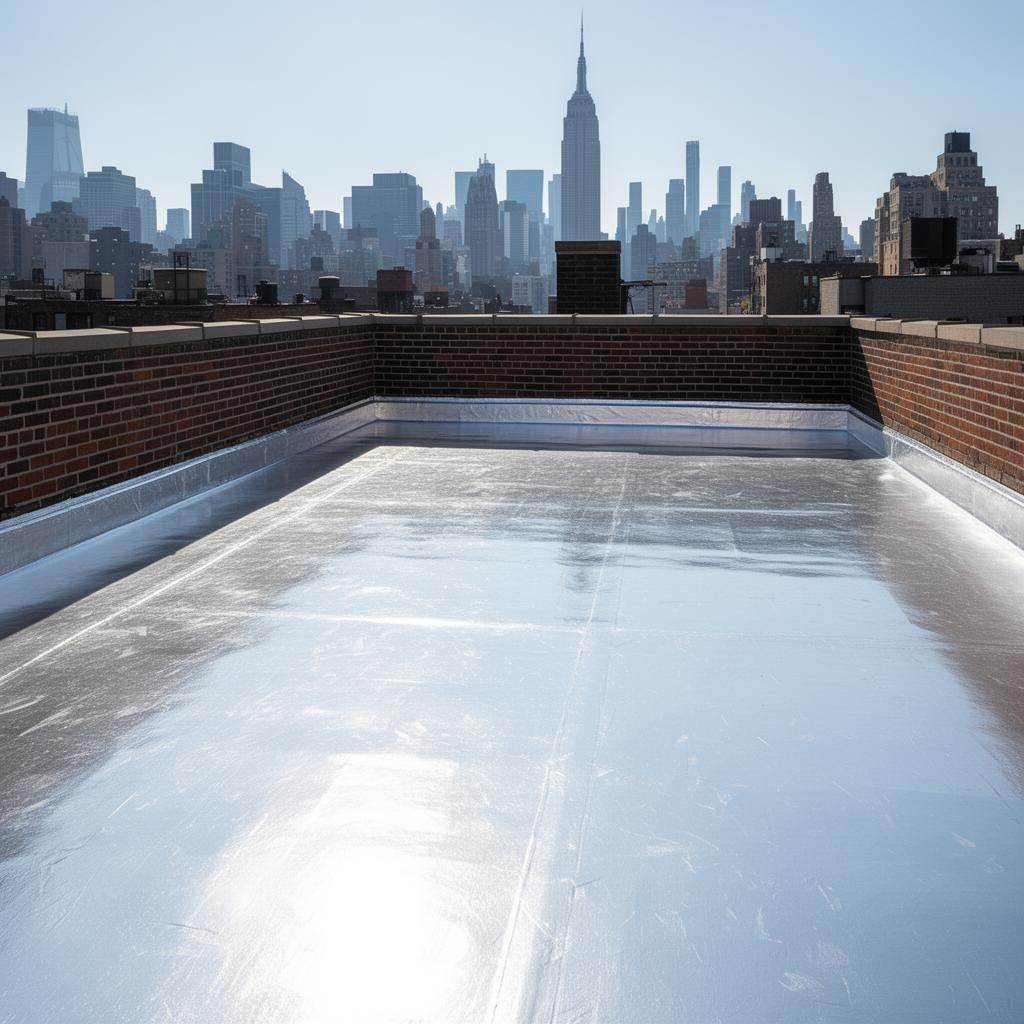
NYC Local Law 94 requires green or cool roofs on most new buildings. Learn what's required, what's exempt, costs, and how IronSky helps NYC property owners comply.