

Ponding Water on a Flat Roof: Causes, Warning Signs & Repair Options
Flat roofs are not flat. They are low-slope roofs, built with a deliberate pitch that moves water toward drains or scuppers. When you see water still standing on a roof two or three days after the rain stopped, that design intent has failed somewhere — and the roof is aging faster than it should, even if nothing is leaking yet.
Ponding is one of those problems that is cheap to fix early and expensive to fix late. This guide explains what causes it, how to recognise it without going on the roof, what it does to the roof assembly over time, and the range of repair approaches.
What counts as ponding
The common working definition among roofers is water that remains on the roof roughly 48 hours after rain ends, in reasonable drying weather. A puddle the morning after a storm is not ponding. A permanent shallow lake in the same corner every time it rains is.
You do not need to be on the roof to spot it. The signs are visible from a window, a neighbouring building, a fire escape landing, or a photo taken with a phone held over a parapet:

Why it happens
Blocked or undersized drainage
By far the most common cause, and the cheapest to correct. Leaves, roofing grit, construction debris and pigeon nesting material collect at drains, strainers and scuppers. Internal leaders can be blocked further down where you cannot see. A roof that drained fine for years and suddenly ponds usually has a drainage problem rather than a structural one.
Insufficient slope from the original construction
Some older low-slope roofs were built with minimal pitch, and some were re-roofed over the years in ways that flattened the original slope. If the roof has ponded in the same places since you have owned the building, and drains are clear, the slope itself is likely the issue.
Structural deflection and settlement
Roof decks deflect. Long spans sag slightly in the middle, buildings settle unevenly, and a deck weakened by previous water damage sags more. Ponding that appears in the middle of a span rather than at an edge often has a structural cause. This one matters, because standing water is heavy — a deflection that collects water gets heavier, which increases the deflection.
Surface irregularities from previous work
Added rooftop equipment, curbs installed across a drainage path, patched areas built up higher than their surroundings, or an HVAC unit set on sleepers that dam the flow — all of these create new low spots. A new pond that appeared after someone else's work on the roof usually has an obvious cause.
What ponding actually does
Ponding rarely punches a hole by itself. What it does is accelerate everything else:
This is why ponding is worth addressing before it becomes a leak. Once water finds a way through, you are dealing with wet insulation and possibly a compromised deck as well as the membrane.
Repair options, cheapest to most involved
Clear and correct the drainage
Clearing drains, strainers, scuppers and leaders, replacing broken strainer baskets, and confirming that internal leaders actually run clear. Often this alone resolves it. On roofs that collect a lot of debris, adding drain guards and putting a clearing schedule in place — twice a year and after major storms — is the practical prevention.
Add a drain or scupper
Where an area of the roof genuinely has nowhere to drain to, adding a drain or a through-wall scupper at the low point gives the water an exit. Less invasive than re-sloping and appropriate when the pond is isolated.
Localised tapered insulation — crickets and saddles
Tapered insulation built up behind a curb or between two drains creates positive slope in a specific area and directs water where it should go. A cricket behind a wide HVAC curb is the standard fix for water damming behind equipment.
Full tapered insulation system
When the roof lacks adequate slope overall, the durable solution is a tapered insulation system installed under a new membrane, engineered so the whole roof drains to its drain points. This is done as part of a flat roof replacement rather than as a repair, and it costs meaningfully more upfront — but it is the difference between a roof that reaches its design life and one that does not.
Structural assessment
Where deflection is suspected, the deck needs to be assessed before membrane work is specified. Adding insulation and membrane over a sagging deck without understanding why it sags is not a fix.
Ponding on Queens roofs
Queens has a very large stock of low-slope roofs on two- and three-family homes, many with rear extensions and later additions whose roofs were tied into the original drainage rather than given their own. Extension roofs and areas around later rooftop equipment are where ponding shows up most often on these buildings. If the pond sits over an addition, the drainage path that addition was given is the first thing to look at. IronSky works across Queens and the surrounding boroughs on exactly this kind of roof.
What to do next
If you can see water standing on your roof more than two days after rain, the useful first step is a proper look at drainage and slope before the next winter's freeze-thaw cycles work on it. That falls under flat roof repair and, where the water is already getting into the assembly, waterproofing work as well.
Request a free estimate below or call to describe what you are seeing — where the water sits, how long it takes to clear, and whether it has always done that.
Get a Free Flat Roof Estimate
Licensed NYC roofers. Written, itemized quote. We respond within the hour during business hours.
- GAF Certified & Firestone Licensed
- Fully licensed & insured in NY State
- Free written estimate — no pressure
- Serving all 5 boroughs since 2008
Frequently Asked Questions
How long can water sit on a flat roof before it is a problem?+
The common benchmark among roofers is 48 hours in reasonable drying weather. A puddle the morning after a storm is normal; water still standing two or three days later indicates a drainage, slope or structural issue.
Does ponding water on its own cause leaks?+
Ponding rarely creates a hole by itself. It accelerates the failure of whatever weakness already exists in that area — a cold weld, a lifted lap, aging flashing — and repeated freeze-thaw cycling in winter makes that faster.
Why does my roof pond in the same spot after every rain?+
Consistent ponding in one location points to blocked drainage at that point, inadequate slope in that area, deck deflection, or an obstruction such as a curb or equipment installed across the drainage path.
How much does standing water weigh?+
Water weighs roughly 5.2 pounds per square foot for every inch of depth. A broad shallow pond therefore adds real load to a roof deck, and because deflection collects more water, the problem tends to compound.
Can ponding be fixed without replacing the roof?+
Often, yes. Clearing and correcting drainage, replacing failed strainers, adding a drain or scupper, or installing tapered crickets and saddles in problem areas are all repairs. A full tapered insulation system is only needed when the roof lacks adequate slope overall, and that is done as part of a replacement.
Does ponding affect a roof warranty?+
Many membrane manufacturers exclude areas of standing water from their warranty coverage. Check the specific terms of your roof's warranty, since the exclusions vary between manufacturers and systems.
Need a roofer in NYC?
IronSky offers free estimates and 24/7 emergency service across NYC, Long Island and Yonkers.
Get Free EstimateRelated Articles
All posts
A room-by-room, roof-by-roof method for tracing a flat roof leak in a Brooklyn rowhouse — membrane seams, flashing, penetrations, drains, ponding and parapets — without setting foot on the roof.
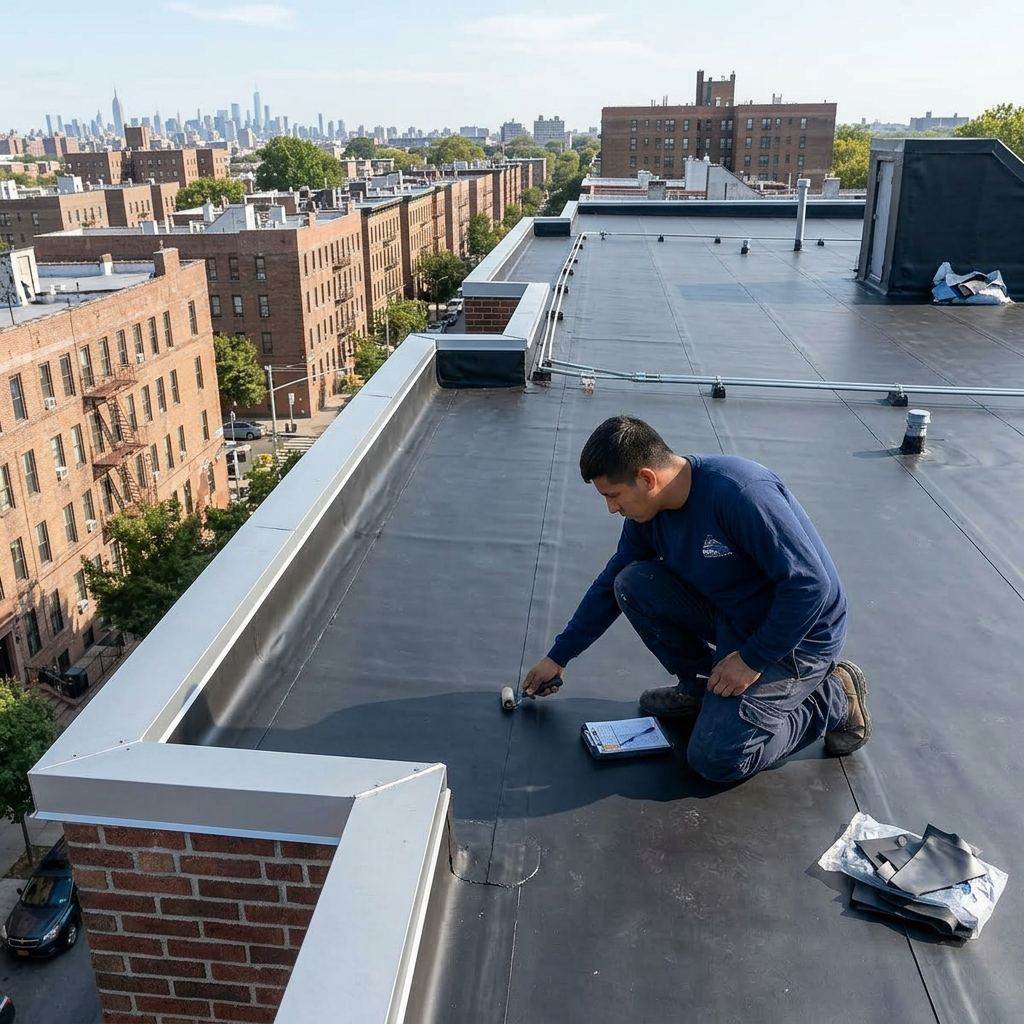
Discover the most common reasons NYC flat roofs leak — from failed flashing to ponding water — and how IronSky fixes them fast. Free inspections available.
NYC Local Law 94 requires green or cool roofs on most new buildings. Learn what's required, what's exempt, costs, and how IronSky helps NYC property owners comply.